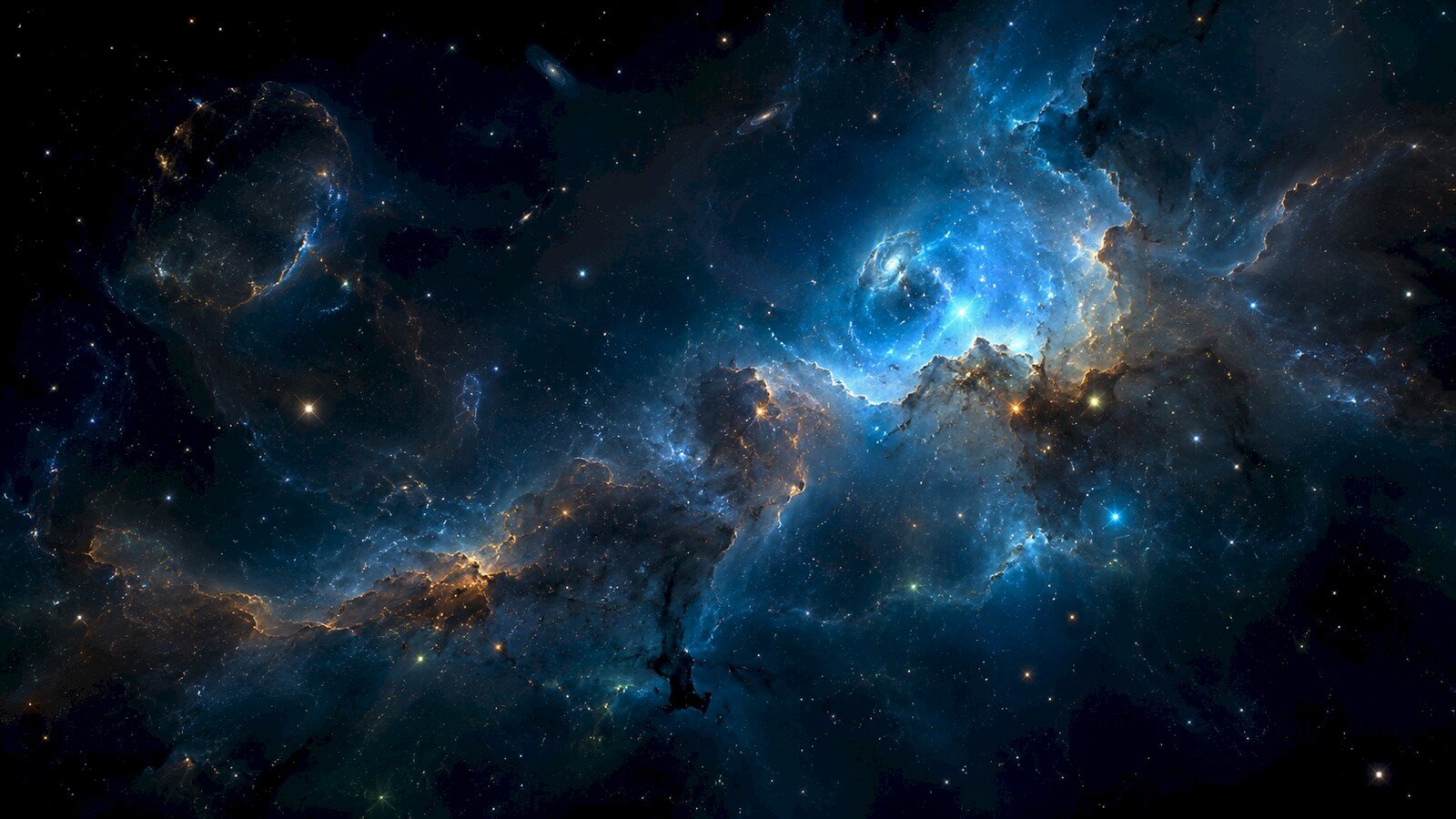
Every breath, every glass of water and every cell in your body carries evidence of events that happened long before Earth existed. The hydrogen in water reaches back toward the early universe. Carbon, oxygen, nitrogen and many of the other elements essential to life were built later, through nuclear reactions inside stars. Some of the rarest heavy elements required even more extreme environments: exploding stars and collisions between stellar remnants.
This is why the familiar idea that we are made of “star stuff” is broadly true—but it is only the middle of a much larger story. Our material history begins before the first star switched on, continues through generations of stellar birth and death, and remains unfinished because astronomers are still discovering how the earliest galaxies formed and how quickly they began changing the chemistry of the cosmos.
The universe began chemically simple
The early universe was hot, dense and expanding. During its first few minutes, protons and neutrons combined in a process called Big Bang nucleosynthesis. This produced the nuclei of hydrogen and helium, along with small traces of a few other light elements. The expansion then cooled the universe too quickly for this first period of element-making to continue.
Complete neutral atoms could not form immediately. For hundreds of thousands of years, free electrons scattered light through the cosmos. About 380,000 years after the Big Bang, the universe had cooled enough for nuclei to capture electrons. Space became transparent, releasing the ancient glow now observed as the cosmic microwave background.
At that stage, there was no Earth, no oxygen to breathe and no carbon chemistry from which known life could emerge. There was mainly hydrogen and helium spread through a dark universe, with slightly denser regions that gravity could gradually pull together.
The universe did not begin with the chemical variety we see around us. It had to manufacture that complexity over cosmic time.
Stars changed the recipe
As gravity gathered primordial gas into denser clouds, their centres became hot and compressed. Nuclear fusion began, and the first stars illuminated the cosmic dark ages. Inside a star, light nuclei can combine into heavier ones. Hydrogen fusion produces helium; later stages in sufficiently massive stars can build carbon, oxygen and a sequence of still heavier nuclei.
Fusion is also the source of a star’s light and heat. A small amount of mass is converted into energy during nuclear reactions, supporting the star against gravitational collapse for much of its life. The exact sequence depends on the star’s mass. A star like the Sun does not follow the same path as a star born with ten or twenty times more mass.
Massive stars can develop layered interiors, with different nuclear reactions occurring in successive shells. Their evolution can produce elements up to the iron group. But iron marks a critical boundary: fusing iron does not release energy in the way that earlier fusion stages do. Once a massive stellar core can no longer gain support from energy-producing fusion, collapse may follow.
The death of a star is therefore not merely an ending. Stellar winds and explosive events return newly made material to surrounding space. That enriched gas and dust can enter later clouds, later stars and later planetary systems. Cosmic chemistry accumulates across generations.
The heaviest elements need violent places
Elements heavier than iron require processes beyond ordinary energy-producing stellar fusion. Some form through slow neutron capture during particular stages of stellar evolution. Others form when atomic nuclei are exposed to an intense flood of neutrons and capture them rapidly. Scientists call this the rapid neutron-capture process, or r-process.
One dramatic r-process environment is a collision between neutron stars—the extraordinarily dense remnants left by some supernovae. In August 2017, the LIGO and Virgo observatories detected gravitational waves from a neutron-star merger known as GW170817. Telescopes then watched light from the same event across many wavelengths. The changing glow of the resulting kilonova provided evidence that heavy elements were being created in the ejected material.
The event connected nuclear physics, astronomy and gravitational-wave science in a single observation. It also strengthened the case that neutron-star mergers contribute substantially to elements such as gold and platinum. Researchers are still determining how much different environments—including mergers, supernovae and various kinds of ageing stars—contribute to the full abundance pattern measured across the universe.
From interstellar matter to Earth
Our Solar System formed about 4.6 billion years ago from a collapsing cloud of interstellar gas and dust. Most of the material collected at the centre and became the Sun. The remaining matter settled into a rotating disk where particles collided, stuck together and gradually built planetesimals, planets, moons, asteroids and comets.
That cloud was not chemically pristine. It already contained material processed by earlier stars. The iron in Earth, the oxygen in its rocks and oceans, and the carbon used by living organisms were inherited from a galaxy that had been recycling matter for billions of years.
Earth did not receive every element from one star or one explosion. Its ingredients were mixed through interstellar space and assembled from a long history of sources. Even atoms of the same element can have different cosmic routes. Some may have formed in one type of star, while others emerged through another process in a different region of the Galaxy.
Life rearranged ancient material
Life did not create the basic elements from which it is built. Biology reorganised existing matter into systems able to store information, use energy, reproduce and evolve. Carbon became a versatile framework for complex molecules. Phosphorus became essential to DNA, cell membranes and energy transfer. Iron became part of proteins that move oxygen through human blood.
This does not make life “separate” from the universe. It makes life one of the ways the universe’s existing matter can become organised under the right physical and chemical conditions. The atoms remain governed by the same laws whether they are in interstellar gas, an ocean, a rock or a living cell.
That continuity is more profound than the slogan that we are made of stars. Some of our hydrogen predates stars. Many heavier nuclei were made by several kinds of stellar and explosive events. Earth assembled those ingredients, and biological evolution later produced living structures from them.
The earliest chapters are still being revised
Astronomers understand the broad outline of cosmic history, but important details remain unsettled. The James Webb Space Telescope is now observing galaxies from the period called cosmic dawn, when the first generations of stars and galaxies were transforming the young universe.
In 2026, researchers reported Webb spectroscopy confirming the galaxy MoM-z14 at a redshift of 14.44. We see it as it existed only about 280 million years after the Big Bang. The research team found that the implied abundance of bright galaxies at this exceptionally early time was more than one hundred times higher than pre-Webb consensus models had predicted.
MoM-z14 also shows an unusual chemical pattern, including strong nitrogen relative to carbon, and possible signs that its surroundings were already partly ionised. Those observations do not erase the Big Bang model or the established physics of stars. They expose gaps in how quickly our models expected early structures and chemical enrichment to develop.
This is how science advances. A model earns confidence by explaining evidence, but it remains open to improvement when better instruments reach territory that earlier observations could not test. Webb is not simply adding more distant objects to a list. It is providing measurements that force astronomers to refine the timeline of the first stars, galaxies and black holes.
What is known—and what remains uncertain
The overall framework is supported by several independent kinds of evidence: the expansion of the universe, the cosmic microwave background, measured abundances of light elements, nuclear experiments, observations of stars at different life stages, meteorites, supernova remnants and gravitational waves.
Within that framework, open questions remain. Astronomers have not directly identified a truly metal-free first-generation star. The relative contributions of different stellar sites to many heavy elements are still being measured. Researchers continue to investigate how quickly the first galaxies formed stars, created dust, enriched themselves with heavier elements and cleared the neutral hydrogen that filled early space.
Uncertainty here is not a weakness to hide. It identifies the boundary between established knowledge and active research. That boundary moves whenever a new detector, telescope, laboratory measurement or analysis reveals something that previous methods could not see.
A connected cosmic history
The atoms in a human body do not share one birthplace or one age. They are a collection assembled from different chapters of cosmic history: primordial nucleosynthesis, stellar fusion, ageing stars, supernovae, neutron-star mergers, interstellar mixing, planetary formation and biological evolution.
We are therefore not only made from the universe. We are made from a universe that changed repeatedly before we appeared—and one whose earliest chapters are still being discovered. Every improved observation can sharpen that history, showing more clearly how a chemically simple cosmos became capable of stars, rocky worlds and living systems able to ask where their own matter came from.
Sources and further reading
- NASA Science — Cosmic History
- U.S. Department of Energy — Nucleosynthesis
- LIGO Scientific Collaboration — GW170817
- NASA Science — Solar System Formation
- NASA Science — Webb and the Early Universe
- Naidu et al. (2026) — MoM-z14 at redshift 14.44
- NASA Science — Webb Pushes the Observable Universe Closer to the Big Bang