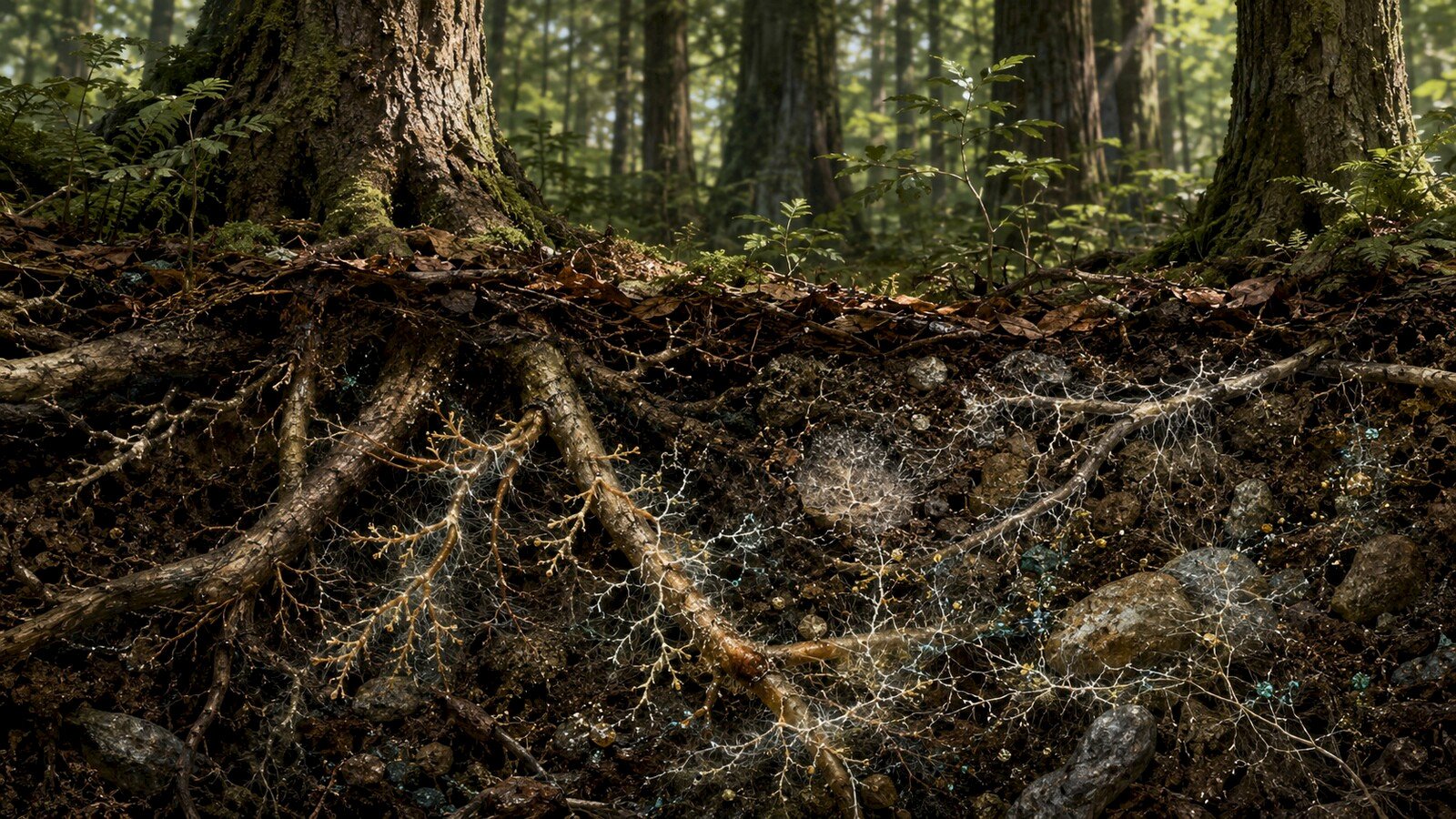
A forest is easy to describe from above: trunks, leaves, birdsong and a ceiling of green. Yet much of the work that keeps trees supplied happens out of sight. At the tips of living roots, fungi build intimate partnerships with plants. Their microscopic filaments extend into soil spaces that roots cannot explore as finely, while the plant sends the fungi carbon compounds made by photosynthesis.
These partnerships are called mycorrhizas. They are not a decorative addition to a forest. They influence how plants obtain phosphorus, nitrogen and water; how carbon moves below ground; how soils are structured; and which tree species prosper in a particular climate. They are also more complicated than the popular image of a benevolent underground internet.
Fungi and plants can cooperate, compete and change the terms of their relationship as conditions shift. Shared fungal networks can connect more than one plant, and experiments have traced material moving between plants. But connection alone does not prove that trees are consciously communicating, feeding their offspring or managing a forest for the common good. The real biology is less sentimental—and more interesting.
A partnership built at the root
A mycorrhiza forms where a compatible fungus colonises a plant root and creates an exchange surface. Outside the root, thread-like fungal cells called hyphae spread through soil. Together, those threads form a mycelium. Because hyphae are much finer than roots, they can reach narrow pores and explore a large volume of soil relative to their size.
The fungus gathers mineral nutrients and water from this environment. Some of those resources cross the mycorrhizal interface into the plant. In return, the plant transfers carbon-rich compounds to its partner. That carbon began as atmospheric carbon dioxide captured by leaves and converted through photosynthesis. A portion of the plant’s recent production therefore enters roots, fungal tissue and the surrounding soil.
This is an exchange between living organisms, not a pipe attached to a passive root. The fungus needs energy and carbon to grow. The plant needs nutrients in forms it can use. Each partner can influence how much it supplies, and the value of the trade depends on what is scarce. A unit of phosphorus matters more to a phosphorus-limited plant than it does to one growing in fertilised soil.
Mycorrhizal fungi do not simply “help trees.” They are organisms pursuing their own survival through a partnership that can reward both sides.
Two major ways to live together
Mycorrhiza is a broad term covering several kinds of association. Two are especially important in forests. Arbuscular mycorrhizal fungi enter the cells of the root cortex and form highly branched structures called arbuscules. Those branches create a large membrane-to-membrane surface across which nutrients can be exchanged. Arbuscular partnerships occur across a vast range of plant lineages and are common in many warm forests and grasslands.
Ectomycorrhizal fungi take a different approach. They usually form a sheath around fine root tips and grow between root cells rather than penetrating them. Many familiar temperate and boreal trees—including pines, oaks, beeches, birches and eucalypts—associate with ectomycorrhizal fungi. The fruiting bodies we recognise as forest mushrooms may be only the temporary reproductive structures of much larger organisms living among roots and soil.
These strategies are unevenly distributed across the planet. A 2019 global analysis estimated that ectomycorrhizal trees represent only a small fraction of plant species but account for roughly 60 per cent of tree stems. Ectomycorrhizal dominance is especially common where seasonal cold or dryness slows decomposition, while arbuscular partnerships dominate many warm, aseasonal tropical forests. Climate, decomposition and nutrient availability all help shape that geography.
What the plant receives
Phosphorus is essential for DNA, cell membranes and the chemistry that transfers energy inside cells. It can also be difficult for a root to obtain because phosphate moves slowly through soil and can become chemically bound. Fungal hyphae extend beyond the nutrient-depleted zone around a root and can deliver phosphorus from farther away.
Nitrogen is another key resource. Different mycorrhizal fungi vary in the compounds and soil layers they can exploit, but many help move nitrogen toward their hosts. Fungal access does not make nutrients unlimited; it changes the plant’s reach and the biochemical routes available to it.
Hyphae can also improve access to water, particularly by exploring tiny soil pores. That does not mean every inoculated tree becomes drought-proof. Results depend on fungal identity, tree species, soil texture, temperature and the severity and duration of water stress. A partnership that is valuable in one setting may provide little benefit in another.
Experiments reveal that the exchange can respond to partner behaviour. In a 2011 study of arbuscular mycorrhizas, plants allocated more carbon to fungal partners that supplied more phosphorus, while fungi delivered more phosphorus where they received more carbon. A later experiment found that carbon availability could stimulate fungal nitrogen uptake and transport. Researchers sometimes describe this as a biological market, but the phrase is a model, not evidence that plants or fungi calculate prices. Local physiological feedbacks can produce selective exchange without intention.
What the fungus receives
Mycorrhizal fungi depend heavily on plant-derived carbon. That carbon is used to maintain cells, extend hyphae, acquire nutrients and reproduce. Recent research has also drawn attention to mycorrhizal mycelium as a substantial pathway through which photosynthetically fixed carbon enters below-ground ecosystems.
Some carbon remains in living fungal biomass. Some is respired back to the atmosphere. Some enters soil food webs or persists after fungal tissue turns over. Estimating the global quantities is difficult because fungal lifespans, growth forms and measurements vary across ecosystems. The safest conclusion is not that fungi permanently lock away a fixed amount of carbon, but that they are major participants in the processes controlling soil carbon formation, movement and loss.
This matters because soil carbon is not an inert vault. It is continually transformed by roots, fungi, bacteria and animals. Changing the fungal community can alter decomposition, nutrient availability and the conditions under which carbon remains in soil. Forest carbon models therefore need to account for the biology below ground, not only trunks and leaves.
When roots share a fungal network
A single fungal individual can sometimes colonise roots belonging to more than one plant. Where mycorrhizal hyphae create that physical connection, researchers call it a common mycorrhizal network. Isotope tracers have shown carbon, nitrogen and other substances moving between plants in some experiments, and a well-known 1997 field study detected net carbon transfer between paper birch and Douglas fir.
Those findings established that below-ground transfer can occur. They did not establish a universal forest welfare system. Material detected in a neighbouring plant may have travelled through a shared fungus, through soil after leaving a root or fungus, or through several pathways. Even when the fungal route is isolated, detecting transfer does not automatically show that the recipient receives enough to grow better or survive.
In 2023, ecologists Justine Karst, Melanie Jones and Jason Hoeksema reviewed influential claims about common mycorrhizal networks. They concluded that field results were too variable and limited to support broad claims that these networks are widespread in forests or routinely improve seedling performance through resource transfer. They found no peer-reviewed, published evidence for the claim that mature trees preferentially send resources and defence signals to their own offspring through the networks.
Other researchers argue that existing experiments and observations support a larger ecological role and that new methods will clarify it. That debate is legitimate. What should be avoided is turning a contested interpretation into a settled fact. “Wood wide web” is a memorable metaphor for physical connectivity, but it becomes misleading when it implies an internet with intentional messages, altruistic donors and central mother-tree managers.
Cooperation can slide along a spectrum
Mutualism does not mean that both partners benefit equally at every moment. The outcome can range from strongly beneficial to nearly neutral, and under some conditions the carbon cost can exceed the plant’s nutritional return. High soil fertility may reduce the value of fungal foraging. Low light may leave a plant with less carbon to exchange. A fungus that is effective with one host may perform differently with another.
Plants also interact with many fungi at once, and fungi can encounter several plants. Add competing roots, decomposers, pathogens, grazing soil animals and changing weather, and the exchange becomes part of a crowded economy. Selection can stabilise cooperation because unproductive partners may receive fewer resources, but no forest-wide referee guarantees a fair result.
This context explains why transplanting a fashionable fungal product is not equivalent to rebuilding a mature forest microbiome. Local fungi are adapted to particular hosts, soils and climates. Successful restoration may depend on protecting soil structure, retaining biological legacies and allowing compatible communities to recover—not simply adding spores and expecting a universal response.
How microscopic partnerships shape forests
At the scale of an individual root, a mycorrhiza is an exchange interface. Across a landscape, millions of those interfaces influence nutrient cycles, plant competition, decomposition and soil formation. Different mycorrhizal strategies can help create distinct nutrient economies: forests differ in how quickly organic matter breaks down, where nitrogen is held and how readily nutrients return to plants.
Fungal diversity also gives plants access to partners with different foraging abilities and environmental tolerances. Losing that diversity can narrow the options available when drought, heat, pollution, logging or species turnover changes conditions. Yet more fungal species is not automatically better in every situation. Function depends on which organisms are present, what they do and how they interact with the local plant community.
Mycorrhizas therefore deserve attention in forestry and climate research, but evidence must match the decision. A general truth—that root–fungus partnerships are important—does not justify assuming that every common network benefits seedlings or that preserving one large tree will maintain a benevolent underground communications hub. Good management needs measurements from the ecosystem and species in question.
What scientists can say with confidence
The strongest picture is already remarkable. Fungi form intimate structures on or inside roots. Their hyphae expand the zone from which plants obtain nutrients and water. Plants supply the fungi with recently fixed carbon. The exchange is regulated, responsive and affected by the surrounding environment. Mycorrhizal strategies are distributed across the world in patterns linked to climate, decomposition and forest composition.
Common fungal networks can exist, and materials can move between connected plants under some conditions. The size, route and biological consequence of that movement vary. Claims about purposeful tree communication, preferential care for relatives or predictable benefits across natural forests require stronger evidence than is presently available.
None of this makes forests less connected. It replaces a comforting fable with a dynamic system of living negotiations. Beneath every step, roots and fungi are building interfaces, testing conditions and exchanging resources at microscopic scales. Forests remain alive not because their organisms behave as one harmonious mind, but because countless relationships keep responding to a world that never stays still.
Sources and further reading
- U.S. Forest Service — Mycorrhizae in forest tree nurseries
- van der Heijden et al. (2015) — Mycorrhizal ecology and evolution: the past, the present, and the future
- Kiers et al. (2011) — Reciprocal rewards stabilize cooperation in the mycorrhizal symbiosis
- Fellbaum et al. (2012) — Carbon availability triggers fungal nitrogen uptake and transport in arbuscular mycorrhizal symbiosis
- Steidinger et al. (2019) — Climatic controls of decomposition drive the global biogeography of forest-tree symbioses
- Simard et al. (1997) — Net transfer of carbon between ectomycorrhizal tree species in the field
- Karst, Jones & Hoeksema (2023) — Positive citation bias and overinterpreted results lead to misinformation on common mycorrhizal networks in forests
- Hawkins et al. (2023) — Mycorrhizal mycelium as a global carbon pool